Morpheme work
Build it, break it, prove it
Students combine word parts and defend the meaning using each part.
Literacy page
Students may understand a health concept and still be blocked by the words used to teach it. These routines move from word parts to context, communication, and clinical action.
The repeatable path
Strong vocabulary instruction gives learners a way to approach unfamiliar terms without lowering the content goal.
Find the familiar part, visual, context clue, or prior experience.
Say the word part and connect it to a plain-language meaning.
Read it, say it, write it, sketch it, and use it with a partner.
Apply the term in a direction, explanation, chart note, or simulation.
The word-building lab
Choose a word part, connect it to meaning, then use the term in context.
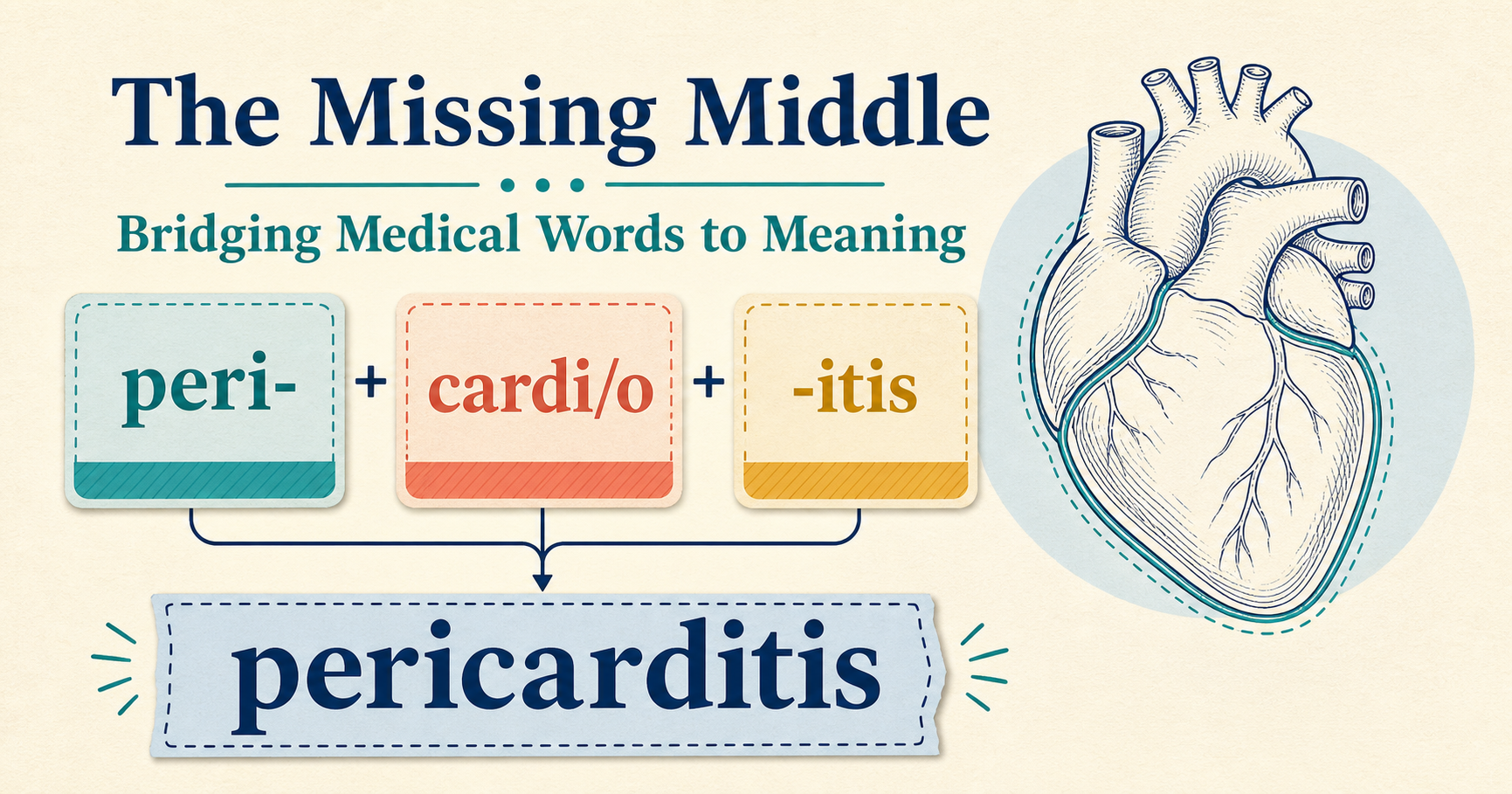
In context
means below / too little
Ask students to explain the word part, sketch its meaning, and use hypoglycemia in a clinical sentence.
The classroom toolkit
Use explicit morphology instruction, retrieval, context, patient communication, and multiple entry points together.
Morpheme work
Students combine word parts and defend the meaning using each part.
Language support
Students read the term, say a student-friendly meaning, and explain it to a patient.
Context clues
Students use the surrounding words in a chart note before checking a glossary.
Retrieval
Short, low-stakes rounds help students find the word when they need it.
Clinical transfer
Students rewrite technical phrases accurately and respectfully.
Differentiation
Visuals, frames, audio, partner reading, and extension cases keep the target consistent.
Games that build retrieval
Low-stakes games give students more chances to retrieve a word, explain it, and use it accurately.
Teams collect one prefix, root, and suffix card, build a possible term, and earn the point only after explaining it in plain language.
Teacher move: Require an explanation before awarding the point.
The teaching moves
These are designed for mixed reading levels, multilingual learners, and students preparing for the language of healthcare.
Sort prefix, root, and suffix cards, then explain how each part changes the meaning of a term.
Circle familiar parts, underline context clues, and draft a working definition from a chart note or textbook sentence.
Turn a technical phrase into accurate, respectful language a patient or family member could understand.
Read a direction, say what it means, perform or simulate the step, and explain why it matters.
Ready to print?